Why Mobile App Backends Need Cloud Hosting, Not Just Any Server
A mobile application — whether it is a social network, a food delivery platform, a fitness tracker, or an enterprise field-service tool — is only as reliable as the backend infrastructure that powers its API endpoints, authenticates its users, stores its data, processes its push notifications, and scales to accommodate its daily active user base. Selecting the right cloud hosting mobile app backend infrastructure is not a trivial extension of web hosting: mobile backends have architectural requirements — intermittent connectivity handling, push notification infrastructure, real-time data synchronization, offline data queuing, geographically distributed user bases with variable network quality — that traditional web hosting was never designed to address. A mobile app backend built on cloud hosting infrastructure — Amazon Web Services, Google Cloud Platform, Microsoft Azure, or infrastructure-as-a-service providers like DigitalOcean, Linode, Vultr, and specialized Backend-as-a-Service platforms like Firebase and Supabase — inherits capabilities that shared hosting and even VPS hosting cannot economically replicate: auto-scaling that adds server instances during usage spikes and removes them during quiet periods, managed database services that handle replication, failover, and backups without administrator intervention, object storage that scales to petabytes without provisioning individual drives, CDN integration that caches API responses and static assets at edge locations near users, and identity management services that implement OAuth, social login, and multi-factor authentication with security that has been audited and penetration-tested by dedicated security teams.
The distinction between cloud hosting for web applications and cloud hosting for mobile app backends centers on the network environment and the interaction patterns that mobile clients create. A web application enjoys a relatively controlled network environment: the user's browser maintains a persistent or semi-persistent connection over a stable broadband or WiFi link, the application interface is delivered as pages that the server renders, and client-side state is limited to cookies and local storage with the browser managing the complexities of caching, retry, and connection persistence. A mobile application operates in a fundamentally hostile network environment: the user transitions between WiFi and cellular networks mid-session, traverses tunnels and elevators where connectivity drops to zero, experiences network latency that varies from 20 ms on 5G to 500 ms on congested 4G or rural connections, and runs on a device where battery conservation policies aggressively terminate background processes and throttle network access. The mobile backend must handle these conditions gracefully — accepting API requests that arrive out of order due to network retransmission, reconciling conflicting data writes from clients that were offline for hours, sending push notifications through platform-specific services (APNs for iOS, FCM for Android) that have their own reliability and latency characteristics, and minimizing the data transferred per API call to respect users' cellular data plans and reduce battery-draining radio wake time. For the foundational definition of what cloud infrastructure actually means — and how it differs from the traditional server model that most website owners intuitively understand — Cloudflare's explanation of cloud computing provides an accessible introduction to the concepts that underpin the mobile backend architectures discussed throughout this article.
The Architecture of a Cloud-Hosted Mobile Backend
API Layer: REST, GraphQL, and Real-Time Protocols
The API layer is the mobile backend's primary interface with the outside world — the set of endpoints that the mobile app calls to authenticate users, retrieve data, submit content, and synchronize state. In a well-architected cloud-hosted mobile backend, the API layer is deployed across multiple compute instances behind a load balancer, with each instance running stateless application code that can be horizontally scaled by adding more instances. The choice of API architecture — REST, GraphQL, or real-time protocols like WebSocket and gRPC — has direct infrastructure implications. REST APIs, the most widely deployed pattern, map cleanly to HTTP caching infrastructure: GET requests for resource listings can be cached at the CDN edge, reducing origin server load and improving response times for users far from the origin data center. GraphQL APIs, which allow mobile clients to request exactly the data they need in a single query rather than making multiple REST calls, reduce the number of network round-trips — a critical optimization for mobile clients on high-latency networks where each round-trip adds hundreds of milliseconds — but they complicate CDN caching because GraphQL queries are typically POST requests that CDNs do not cache by default. Real-time protocols — WebSocket for bidirectional streaming, gRPC for high-performance service-to-service communication — require persistent connections that load balancers must be configured to support (session affinity, connection draining, WebSocket upgrade headers) and that consume server resources (memory per connection, open file descriptors) in proportion to the number of concurrently connected devices, not the number of requests per second.
The API layer's deployment pattern on cloud hosting determines both its scalability and its cost. Serverless deployment — AWS Lambda with API Gateway, Google Cloud Functions with Firebase Hosting, Azure Functions — scales automatically from zero to thousands of concurrent invocations, charges per request rather than per instance-hour, and eliminates server provisioning and patching entirely. This model is ideal for mobile backends with variable or unpredictable traffic — an app that sits idle most of the day but experiences usage spikes during commute hours or during a push notification campaign — because you pay only for the compute time actually consumed rather than for idle server capacity. Containerized deployment — Docker containers orchestrated by Kubernetes (EKS, GKE, AKS) or a simpler service like AWS ECS, Google Cloud Run, or Azure Container Apps — provides more control over the runtime environment, supports long-lived WebSocket connections that serverless platforms struggle with, and enables consistent deployment across development, staging, and production environments. Traditional virtual machine deployment on cloud VPS instances provides the most control and the most predictable pricing but requires the most operational work — instance provisioning, operating system patching, scaling policy configuration, and capacity planning. The appropriate API layer deployment model for a given mobile app depends on the app's traffic patterns, latency requirements, team size, and operational expertise, and many mobile backends combine multiple deployment models — serverless for bursty notification-handling functions, containerized for the core API with WebSocket support, and VM-based for stateful services like game servers. For a comprehensive explanation of the hosting technologies that support these deployment patterns, our guide to dedicated servers explains how dedicated infrastructure fits into the hosting hierarchy alongside cloud-native deployment models.
Database Layer: Relational, NoSQL, and Mobile-Specific Considerations
The database layer of a cloud-hosted mobile backend must address challenges that are specific to mobile application data patterns: eventual consistency for offline-capable applications, conflict resolution for data modified on multiple devices while disconnected, geospatial querying for location-based features, and the ability to synchronize subsets of data to individual devices based on user permissions and device storage constraints. Relational databases — PostgreSQL, MySQL — hosted on managed cloud database services (AWS RDS, Google Cloud SQL, Azure Database) provide the ACID transaction guarantees, complex querying, and referential integrity that applications with structured, interrelated data (user accounts, orders, payments, inventory) require, and their managed service form eliminates the operational burden of replication configuration, failover management, backup scheduling, and version upgrades. A managed PostgreSQL instance on AWS RDS with Multi-AZ deployment provides automatic failover to a standby replica in a different availability zone within 60 to 120 seconds of a primary instance failure, with synchronous replication ensuring zero data loss — a level of database reliability that would require significant engineering effort to achieve on a self-managed VPS.
NoSQL databases — MongoDB (via MongoDB Atlas), Amazon DynamoDB, Google Firestore — address mobile backend requirements that relational databases handle less naturally: schema flexibility for applications where the data model evolves rapidly during development, horizontal scaling across distributed clusters for applications with tens of millions of users, and document-oriented data models that map directly to the JSON objects that mobile apps send and receive. DynamoDB's on-demand capacity mode, which scales read and write throughput automatically without capacity planning, is particularly well-suited to mobile backends with unpredictable traffic — a social app where a viral post can trigger a thousandfold increase in read traffic within minutes. Firebase's Firestore, a NoSQL document database integrated with Google's Firebase Backend-as-a-Service platform, adds real-time synchronization: when data changes in Firestore, all connected mobile clients receive the update automatically through a persistent WebSocket connection, eliminating the need for the mobile app to poll the API for changes. This real-time synchronization capability is transformative for collaborative applications — shared to-do lists, multi-player games, real-time document editing — but it introduces a different cost model (charged per document read, write, and delete) that can become expensive at scale if the data model is not optimized for Firestore's pricing structure. For AI-powered mobile applications that require specialized database configurations — recommendation engines, personalization models, natural language search — our guide to dedicated server hosting for AI and machine learning workloads explains the infrastructure requirements that emerge when machine learning models become part of the mobile backend's data processing pipeline.
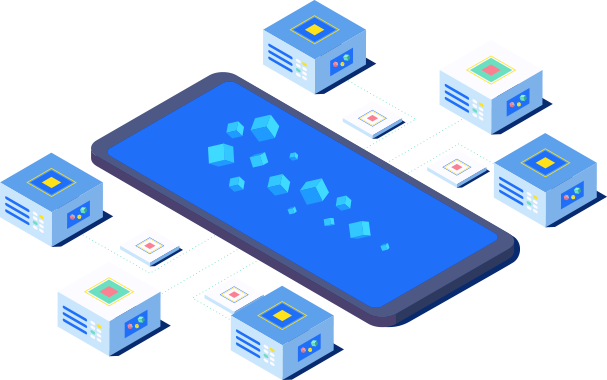
Illustration: Cloud Hosting for Mobile Apps: Backend Infrastructure BasicsAuthentication, Push Notifications, and Mobile-Specific Services
Authentication: OAuth, Social Login, and Token Management
Mobile app authentication presents challenges that web application authentication largely avoids: the authentication token must persist across app restarts without requiring the user to log in again, the token must be stored securely on a device that could be lost, stolen, or compromised by malware, and the authentication flow must handle the case where the user's access token expires while the app is in the background and the next API call must transparently refresh the token without interrupting the user experience. Cloud-hosted authentication services — AWS Cognito, Google Firebase Authentication, Auth0, Clerk — provide pre-built implementations of these flows: OAuth 2.0 with PKCE for secure mobile authentication, social login integration with Apple (mandatory for iOS apps that offer any social login), Google, Facebook, and other providers, token refresh with secure storage of refresh tokens in the platform's credential storage (iOS Keychain, Android Keystore), and multi-factor authentication with TOTP or SMS verification. These services handle the security-critical aspects of authentication — password hashing with bcrypt or Argon2, brute-force protection through rate limiting and account lockout, session management with token revocation — that, if implemented incorrectly in custom code, would create vulnerability points that compromise every user account.
The authentication service's pricing model and geographic deployment are infrastructure considerations that affect both cost and latency. AWS Cognito charges per monthly active user, with pricing tiers that make it economical for consumer applications but potentially expensive for applications with large authenticated user bases and frequent authentication events. Firebase Authentication provides a generous free tier with unlimited authentication events, but it operates within Google's infrastructure and may not satisfy data residency requirements that mandate authentication data remain within specific geographic boundaries. Auth0 and Clerk provide more sophisticated features — organization management, role-based access control, enterprise single sign-on integration — at higher per-user pricing that is appropriate for B2B and enterprise mobile applications. The authentication service's API endpoint latency directly affects the mobile app's initial launch experience — the time between app open and the first screen of personalized content — because authentication is typically the first API call the app makes. Deploying the authentication service in the cloud region closest to the majority of your users, or using an authentication service with globally distributed endpoints, minimizes this cold-start latency.
Push Notifications: APNs, FCM, and Delivery Reliability
Push notifications are the primary mechanism by which a mobile backend proactively communicates with users — alerting them to new messages, delivery status changes, social interactions, breaking news, or app updates — and the infrastructure that delivers push notifications must bridge between your cloud-hosted backend and the platform-specific notification services operated by Apple (APNs) and Google (FCM). The reliability of push notification delivery is not guaranteed by APNs or FCM: both services operate on a best-effort delivery model where notifications may be delayed, coalesced, or dropped entirely by the operating system's power management policies, the device's network connectivity state, or the user's notification settings. The cloud-hosted backend's responsibility is to ensure that the notification is correctly formatted, targeted to the correct device token, and transmitted to APNs or FCM with appropriate priority and expiration settings — and then to handle the delivery feedback from APNs and FCM that indicates whether the device token is still valid, whether the app has been uninstalled, and whether the notification was successfully displayed.
Push notification infrastructure on cloud hosting typically involves a message queue (AWS SQS, Google Pub/Sub, RabbitMQ) that receives notification requests from the application logic, worker processes that consume the queue and format notifications for each platform, and a connection pool to APNs and FCM that manages authentication tokens (APNs requires JWT-based authentication with regularly rotated signing keys) and handles connection failures, rate limiting, and feedback processing. AWS Simple Notification Service (SNS) provides a managed push notification service that handles the platform-specific formatting and delivery for APNs, FCM, and other platforms, reducing the operational burden to publishing a message to an SNS topic with the target device tokens. Firebase Cloud Messaging provides a unified interface for sending notifications to iOS, Android, and web clients from a single API call, automatically routing to the appropriate platform-specific service. The choice between building custom notification infrastructure and using a managed service depends on the volume of notifications, the complexity of targeting and personalization logic, and whether the notification pipeline needs to integrate with marketing automation, A/B testing, or analytics systems that a managed service may not support with the required granularity.
Offline Support, Data Synchronization, and Conflict Resolution
The capability that most distinguishes a mobile backend from a web backend is offline support — the ability for the mobile app to remain functional when network connectivity is unavailable and to synchronize locally accumulated data with the server when connectivity is restored. Implementing offline support in a cloud-hosted backend requires architectural decisions at every layer: the mobile client must implement a local database (SQLite, Realm, CoreData with CloudKit) that stores a subset of the server's data, the API must support incremental synchronization where the client sends only the records that have changed since the last successful sync rather than the entire dataset, the server must implement conflict resolution logic that determines what happens when the same record is modified on two different devices while both were offline, and the synchronization protocol must handle the edge cases — a record that was deleted on the server while the client was offline and modified on the client, a schema migration that the client has not yet received, a synchronization that times out partway through and must be resumed without duplicating data or losing changes.
Cloud-hosted data synchronization services — AWS AppSync, Google Firebase Realtime Database and Firestore, Couchbase Mobile with Sync Gateway, Realm with MongoDB Atlas Device Sync — provide pre-built synchronization infrastructure that handles the transport layer, the conflict detection, the delta computation, and the conflict resolution strategy (last-write-wins, custom merge functions, manual conflict resolution). These services maintain a persistent WebSocket or HTTP long-polling connection between each mobile client and the cloud-hosted synchronization endpoint, streaming changes in both directions as they occur and queuing changes on the server when the client is offline. The infrastructure cost of synchronization services scales with the number of concurrently connected devices (each persistent connection consumes server memory and a file descriptor), the frequency of data changes (each change triggers a push to every subscribed client), and the volume of data being synchronized (the synchronization protocol must compute and transmit the delta between the client's last known state and the current server state for every sync event). HostingCaptain's cloud hosting consultation services help mobile development teams evaluate whether their app's offline requirements justify the operational complexity of real-time synchronization infrastructure, or whether a simpler API-based architecture with client-side caching and periodic full-sync operations can satisfy the user experience requirements at lower infrastructure cost and complexity.
Scaling: From Prototype to Millions of Users
The cloud hosting model's defining operational advantage for mobile backends is elastic scalability — the ability to provision additional compute, database, storage, and networking capacity in minutes rather than the days or weeks required to procure, rack, and configure physical servers. A mobile app that launches with 1,000 beta users on a single cloud instance or a serverless architecture can scale to 100,000 users by adding instances behind a load balancer, to 1 million users by introducing database read replicas and caching layers, and to 10 million users by adopting a microservice architecture where individual backend services (authentication, user profiles, content feeds, notifications, analytics) scale independently according to their own load characteristics. This graduated scalability path — start small, scale incrementally, pay only for what you use — aligns cloud hosting costs with mobile app revenue in a way that traditional hosting infrastructure cannot, because you are never paying for the 10-million-user infrastructure while you are still at the 10,000-user stage.
The scaling bottlenecks for mobile backends follow a predictable sequence that development teams can monitor and preempt. The first bottleneck is typically the database: a single database instance handling both reads and writes becomes saturated as concurrent connections increase, and the solution — adding read replicas for read-heavy API endpoints, implementing query result caching with Redis or Memcached, and eventually sharding the database across multiple instances — is well-supported by managed cloud database services that provision read replicas with a few clicks. The second bottleneck is the API compute layer: individual API instances reach CPU or memory saturation, and the solution — horizontal scaling behind a load balancer with health checks and automatic instance replacement — is the foundational capability of cloud auto-scaling groups. The third bottleneck is more subtle: network throughput and connection limits on individual load balancers, API rate limiting on third-party services (push notification delivery rates, social login API quotas, map and geocoding service limits), and the cost trajectory of managed services at scale — the DynamoDB or Firestore bill that was negligible at 10,000 users can become the dominant infrastructure cost at 1 million users, necessitating a migration to self-managed databases on cloud instances. For applications that outgrow the cloud model's cost-efficiency at massive scale and consider migrating to dedicated physical infrastructure, our guide to dedicated server renewal pricing provides the cost comparison framework for evaluating the transition from cloud to bare-metal hosting. For AI-powered mobile apps that require specialized backend infrastructure, our introduction to AI hosting concepts explains the GPU and TPU infrastructure that supports on-device and server-side AI features in mobile applications.
Frequently Asked Questions
What is the simplest way to host a mobile app backend for a new app with no users yet?
For a new mobile app in the prototype or early-launch phase, a Backend-as-a-Service platform like Firebase or Supabase provides the fastest path to a functional backend with minimal infrastructure configuration. Firebase provides authentication (email, social, phone), a NoSQL real-time database (Firestore), file storage, push notifications (FCM), and serverless functions — all accessible through mobile SDKs that handle the networking, caching, and offline persistence layers that would otherwise need to be built from scratch. Supabase provides a similar BaaS experience built on PostgreSQL, offering a relational database, authentication, file storage, and real-time subscriptions with an open-source core that can be self-hosted if you later need to migrate off the managed service. The BaaS approach is appropriate for apps that need to validate their product concept quickly and that can operate within the BaaS platform's data model and pricing constraints — the trade-off is that migrating off a BaaS to custom cloud infrastructure becomes more complex as your data grows and your application's architectural requirements diverge from the BaaS platform's capabilities.
How much does cloud hosting for a mobile app backend actually cost per month?
Cloud hosting costs for a mobile backend range from zero (Firebase's free tier, AWS Free Tier, Supabase free tier) for a prototype with a few hundred users to $50–$200 per month for an app with 10,000 to 50,000 active users on moderate cloud infrastructure (2–4 compute instances, managed database, CDN, basic monitoring) to $1,000–$5,000 per month for an app with 100,000 to 500,000 active users requiring multiple services, database read replicas, caching layers, and production-grade monitoring and logging. The cost variance is driven primarily by database choice (managed relational databases cost more than managed NoSQL at small scale, but the relationship can invert at large scale), the proportion of real-time versus request-response API traffic, the volume of data stored and transferred, and whether the architecture uses serverless (cost-efficient for variable traffic) or provisioned instances (cost-efficient for steady traffic). The most common cost surprise for mobile backend operators is the data transfer (egress) cost — cloud providers charge $0.05 to $0.12 per GB for data transferred from their infrastructure to the internet, and a mobile app that serves high-resolution images, video content, or frequent API responses can accumulate hundreds of dollars in monthly egress charges at moderate scale. Using a CDN with competitive egress pricing and optimizing API response sizes are the primary cost-control measures for data-transfer-heavy mobile backends.
How does HostingCaptain support mobile app backend hosting?
HostingCaptain's VPS and dedicated server hosting plans provide the foundational compute, storage, and network infrastructure for mobile app backends that benefit from predictable pricing, full configuration control, and dedicated resources — particularly for apps with steady, predictable traffic where provisioned instances are more cost-effective than cloud auto-scaling, and for apps that process or store data subject to regulatory requirements that mandate specific data center locations or infrastructure configurations. Our VPS plans, available in multiple geographic locations, provide the API compute layer and self-managed database hosting for mobile backends, while our dedicated server plans provide the single-tenant physical infrastructure appropriate for mobile backends with high data throughput requirements (real-time video processing, large-file synchronization), strict data residency requirements that prohibit multi-tenant infrastructure, or cost profiles where dedicated hardware is more economical than equivalent cloud resources at sustained high utilization. For mobile development teams evaluating their backend hosting options, our support engineers can assess your application's architecture, traffic patterns, and growth projections to recommend the infrastructure configuration — cloud, VPS, dedicated, or hybrid — that optimizes for your specific requirements.
Arjun Mehta is a cloud infrastructure consultant specializing in bare-metal architectures, network routing, and high-traffic database clustering.
Frequently Asked Questions
This guide covers the practical decision points — pricing, performance, and when it makes sense for your situation — based on current 2026 data.
Pricing varies by provider and plan tier; see the cost breakdown section above for current ranges and what's actually included at each price point.
Look closely at uptime guarantees, renewal pricing (not just the first-year discount), and how responsive support actually is — all covered in detail in this article.
Hosting Captain has been exceptional for my e-commerce store in Pune. The NVMe SSD speed is
noticeable, and their support team responds within minutes. Highly recommended for any
Indian business!
Ryan John, Pune
Great Value for Money
Switched from a US-based host to Hosting Captain and my website loads 3x faster for Indian
visitors. The free SSL and cPanel are great, and the pricing is unbeatable. Very satisfied
customer!
Priya Mehta, Mumbai
Reliable VPS Hosting
I've been using their VPS plan for 2 years now. 99.9% uptime is not just a claim — it's
reality. My client projects run without interruption. The KVM virtualization gives me full
control I need.
Amit Kumar, Bangalore
Excellent 24/7 Support
The support team helped me migrate my entire WordPress site at 2 AM without any downtime.
This level of service is rare in Indian hosting. Worth every rupee!
Sunita Patel, Ahmedabad
Perfect for Startups
As a startup, budget matters. Hosting Captain's Business plan covers everything we need —
multiple websites, free SSL, daily backups — at a fraction of what international hosts
charge.
Vikram Singh, Delhi
Professional Dedicated Server
Our high-traffic news portal needed a dedicated server. Hosting Captain's DS Business plan
handles 100K+ daily visitors effortlessly. Their team provisioned everything within 4 hours!
Meena Krishnaswamy, Chennai
Trusted Technologies & Partners
Start Your Website with Hosting Captain
From personal blogs to enterprise solutions, we've got you covered!