Cloud GPU instances dominate the conversation around AI infrastructure, and for good reason — they offer elastic scaling, preconfigured ML environments, and the ability to spin down resources when idle. But as AI workflows move from experimentation to production, a growing segment of practitioners are discovering that dedicated server AI workloads — running on bare-metal hardware provisioned exclusively for a single tenant — offer cost, performance, and control advantages that cloud instances cannot match. Arjun Mehta, who has architected dedicated server deployments for AI research labs and production ML pipelines alike, examines when dedicated hardware makes sense and how to configure it correctly.
When Dedicated Servers Beat Cloud GPU Instances
Cloud GPU instances from AWS, Google Cloud, and Azure carry a convenience premium. An on-demand NVIDIA H100 instance may cost $3–$5 per GPU-hour, or roughly $2,190–$3,650 per GPU-month for 24/7 operation. Reserved instances and committed-use discounts can reduce this to $1.50–$2.50 per GPU-hour, but the monthly cost remains substantial — $1,100–$1,825 per GPU-month.
A dedicated server with 4× NVIDIA H100 GPUs, provisioned through a hosting provider on a monthly contract, typically costs $4,000–$6,000 per month — roughly $1,000–$1,500 per GPU-month. At that pricing, the crossover point where dedicated servers become cheaper than cloud instances occurs at approximately 50% continuous utilization: if your GPUs run inference or training jobs more than 12 hours per day on average, dedicated hardware is cheaper. For teams running continuous fine-tuning pipelines, 24/7 inference services, or multi-day training runs, the savings are dramatic — 30–50% lower total cost over a 12-month period.
Beyond raw cost, dedicated servers offer several technical advantages for AI workloads: predictable performance with no noisy-neighbor interference from other tenants on the same physical GPU, full control over the software stack including custom kernel modules and CUDA driver versions, the ability to use NVIDIA MIG (Multi-Instance GPU) partitioning for workload isolation, and direct NVLink interconnect between GPUs within the same server for multi-GPU training without the latency penalty of networked GPU clusters. For background on the fundamentals of dedicated hosting, see HostingCaptain's complete dedicated server guide.
GPU Selection for Dedicated AI Servers
The GPU is the heart of an AI dedicated server, and selecting the right model requires balancing memory capacity, compute throughput, interconnect bandwidth, and power budget. As of mid-2026, the primary GPU options available in dedicated server configurations break down as follows.
NVIDIA H100 (80 GB HBM3): The current flagship for training and large-scale inference. 80 GB of HBM3 memory with 3.35 TB/s bandwidth, 3,958 teraflops of FP8 compute for training, and NVLink 4.0 with 900 GB/s interconnect per GPU. A 4× H100 server, interconnected via NVLink, functions as a single logical GPU with 320 GB of unified memory — sufficient to fine-tune a 70B-parameter model with reasonable batch sizes. Power consumption: approximately 700 W per GPU under load, requiring liquid cooling in most data center configurations.
NVIDIA L40S (48 GB GDDR6): Positioned for inference and light fine-tuning. 48 GB of GDDR6 memory with 864 GB/s bandwidth, 1,466 teraflops of FP8, and lower power consumption (350 W per GPU) that allows air cooling in standard data center racks. The L40S is the most cost-effective option for inference-only workloads serving language models up to 13B parameters or image generation pipelines (Stable Diffusion, DALL-E-style models) and is typically available in dedicated server configurations at roughly half the monthly cost of H100 servers.
NVIDIA A100 (40 GB or 80 GB HBM2e): The previous-generation workhorse, still widely available in dedicated hosting inventory as cloud providers cycle to H100. 80 GB HBM2e with 2 TB/s bandwidth, 1,248 teraflops of FP16 for training. At a roughly 30% discount to H100 on the dedicated server market, A100 servers represent strong value for teams whose workloads do not require FP8 precision or the higher memory bandwidth of H100.
AMD MI300X (192 GB HBM3): AMD's entry into the dedicated AI server market in 2026 has been significant. The MI300X offers 192 GB of HBM3 memory per GPU — more than double the H100 — and 5.3 TB/s of memory bandwidth. This makes it particularly suitable for inference of very large models (70B+ parameters) where model weight memory footprint is the binding constraint. Availability in dedicated hosting configurations is increasing but still lags behind NVIDIA options. ROCm software stack maturity and framework compatibility should be verified before committing.
For teams getting started with AI infrastructure and evaluating whether to self-host, HostingCaptain's introduction to AI hosting provides broader context on the infrastructure landscape beyond dedicated hardware.
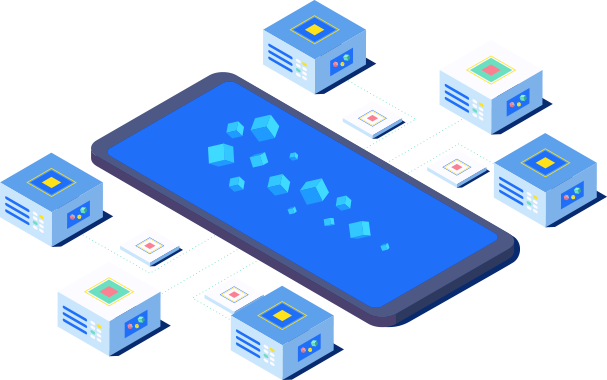
Illustration: Dedicated Server Hosting for AI and Machine Learning WorkloadsCPU, RAM, and Storage: The Supporting Cast That Matters
GPU specifications dominate the conversation, but AI workloads place extreme demands on the supporting components. Under-provisioning CPU, RAM, or storage can create bottlenecks that starve expensive GPUs of data, wasting the investment in high-end accelerators.
CPU requirements: AI workloads are I/O-intensive. Data loading from storage, preprocessing (tokenization, augmentation, normalization), and feeding batches to the GPU all consume CPU cycles. A rule of thumb for dedicated AI servers: allocate at least 8 high-frequency CPU cores per GPU, with preference for CPUs with high single-threaded performance and large L3 cache. Dual Intel Xeon Gold or AMD EPYC configurations with 32–64 cores total are typical for 4-GPU servers. Avoid low-frequency, high-core-count CPUs designed for scale-out web serving; they are poorly suited to AI data pipelines that depend on single-threaded data loading performance.
RAM requirements: System RAM must accommodate the dataset in memory for efficient data loading, plus overhead for the operating system and framework runtime. For computer vision training with large image datasets (e.g., millions of high-resolution images), 512 GB–1 TB of RAM may be necessary to avoid disk I/O bottlenecks during training. For NLP fine-tuning with tokenized text datasets, 128–256 GB is typically sufficient. RAM bandwidth matters: DDR5 at 4,800 MT/s or higher, in configurations that populate all memory channels, provides the throughput necessary to keep GPUs fed.
Storage architecture: AI workloads demand both high capacity and high throughput from storage. A dedicated AI server should have a tiered storage architecture: NVMe SSDs (2–4 TB in RAID 1 or RAID 10) for the operating system and active datasets; high-capacity SATA SSDs or HDDs (8–20 TB in RAID 5 or RAID 6) for dataset archives, model checkpoints, and experiment logs; and a network-attached or cloud object storage bucket for long-term backup. NVMe throughput is critical — a single H100 can consume data at over 3 TB/s from its HBM, and while the GPU does not read directly from storage, the data loading pipeline must sustain hundreds of MB/s per GPU to avoid training stalls.
Networking: Inter-GPU and External Connectivity
Network architecture for dedicated AI servers involves two distinct concerns: inter-GPU communication within the server for multi-GPU training, and external connectivity for data ingestion, model serving, and management.
Inter-GPU communication: Multi-GPU training uses data parallelism (each GPU processes a subset of the batch, gradients are synchronized) or model parallelism (model layers are split across GPUs). Both require high-bandwidth, low-latency communication between GPUs. NVLink, NVIDIA's proprietary interconnect, provides 900 GB/s per GPU pair on H100 — far exceeding PCIe 5.0 at 128 GB/s. A dedicated server with NVLink bridging between all GPUs enables near-linear scaling for multi-GPU training. Servers without NVLink, or with only peer-to-peer PCIe communication, will see diminishing returns beyond 2 GPUs for most training workloads.
External network connectivity: Dedicated AI servers need at least 10 Gbps public network connectivity for model weight downloads, dataset transfers, and serving inference API requests. A 1 Gbps connection becomes a bottleneck when downloading a 70B-parameter model (140 GB at FP16), which takes approximately 19 minutes at 1 Gbps versus under 2 minutes at 10 Gbps. For teams running frequent experiments with large models, the time savings from 10 Gbps connectivity are material. A secondary 1 Gbps management interface (IPMI/iDRAC for remote console and power management) should be provisioned on a separate physical port for out-of-band access during configuration issues.
Software Stack Configuration for Bare-Metal AI Servers
Cloud GPU instances come with preconfigured deep learning AMIs or container images. Dedicated servers require the operator to configure the software stack, from the operating system up through the framework layer. Doing this correctly avoids driver conflicts, CUDA version mismatches, and library incompatibilities that waste GPU-hours.
Operating system: Ubuntu Server 22.04 LTS or 24.04 LTS is the de facto standard for AI workloads, with the widest NVIDIA driver support and the most current CUDA toolkit packages. RHEL/Rocky Linux variants are used in environments with enterprise Linux standardization requirements, but driver availability lags Ubuntu by 1–2 months. Avoid Windows Server for GPU compute — CUDA on WSL2 has improved but still imposes a 5–10% performance penalty and adds a virtualization layer that complicates debugging.
GPU driver and CUDA toolkit: Install NVIDIA drivers via the official repository (not the Ubuntu `nvidia-driver-*` packages which may lag the current release) and use CUDA toolkit 12.x for H100 and L40S GPUs which require CUDA 12 for full feature support. The CUDA toolkit version must align with the framework version: PyTorch 2.5+ requires CUDA 12.1+; TensorFlow 2.16+ requires CUDA 12.3+.
Container runtime: Docker with the NVIDIA Container Toolkit (`nvidia-docker2`) is the standard approach for environment isolation. Containerizing AI workloads ensures reproducibility — the exact combination of CUDA version, Python version, framework version, and dependency libraries is captured in the container image, avoiding the drift that occurs on long-lived bare-metal installations.
Framework selection: PyTorch dominates research and production for transformer-based models. JAX, with its functional programming model and automatic parallelization across TPU and GPU, is gaining adoption for large-scale training. TensorFlow remains widely deployed in production serving environments. Install frameworks via their official Docker images or via `pip` in a Conda environment; avoid installing via `apt` which typically provides outdated versions.
Security Hardening for Dedicated AI Servers
AI servers holding proprietary models, training datasets, and inference API keys are high-value targets. Security configuration for dedicated AI servers goes beyond the standard server hardening checklist — which is essential but insufficient — to address AI-specific threat vectors.
The foundational security measures apply: SSH key-only authentication with password authentication disabled, a configured firewall limiting access to necessary ports (22 for SSH, 443 for inference API, and any model serving ports), regular OS and driver updates, and comprehensive logging with centralized log aggregation. HostingCaptain's dedicated server security hardening checklist covers these measures in detail.
AI-specific security measures include: encrypting model weight files at rest to prevent model theft if physical drives are removed or cloned; network isolation of the inference API from the management plane so that a compromise of the public-facing inference endpoint does not grant SSH access; model access logging — recording every inference request with timestamp, source IP, prompt content (if privacy policy permits), and model response — for audit trails and abuse detection; and prompt injection defenses for LLM inference endpoints, including input sanitization and output filtering to prevent jailbreak attacks and data exfiltration via prompt engineering. GPU-specific resource isolation (NVIDIA MIG partitioning) can also limit the blast radius if a single model serving container is compromised — a compromised container can only access its assigned GPU partition, not the entire GPU or other tenants' partitions.
Cost Analysis: Dedicated Server vs. Cloud for AI Workloads
The decision between dedicated servers and cloud instances for AI workloads is fundamentally a utilization economics question. Here is a realistic cost comparison for a team running a mix of continuous fine-tuning and 24/7 inference.
Cloud cost (on-demand, 24/7): Approximately $14,000–$18,000/month. With 1-year reserved instances: $9,000–$11,000/month. With 3-year reserved instances: $6,500–$8,500/month. These figures exclude data egress charges, which can add $500–$2,000/month depending on dataset and model weight transfer volumes — egress charges are a notorious cloud hidden cost for AI workloads.
Dedicated server cost: $4,000–$6,000/month on a monthly or annual contract from a hosting provider. Setup fee typically $200–$500 one-time. Network bandwidth is unmetered or has a generous included allocation (10–50 TB/month). No egress charges within the provider's network.
Breakeven analysis: At continuous 24/7 utilization, dedicated servers are 50–60% cheaper than on-demand cloud and 25–35% cheaper than 1-year reserved instances. At 50% utilization (12 hours/day), dedicated servers are approximately cost-equivalent to on-demand cloud and 15–25% more expensive than reserved instances — at which point the cloud's elasticity advantage (ability to scale down during idle periods) favors cloud. Teams should audit their actual GPU utilization before committing to dedicated hardware; if GPUs are idle for more than 50% of hours, cloud instances with auto-scaling are likely more economical. For background on navigating hosting renewal pricing to avoid surprises when contracts end, see dedicated server renewal pricing.
Managed vs. Unmanaged Dedicated AI Servers
Dedicated servers are offered in two service models: unmanaged (the provider supplies hardware, network, and power; you configure and manage everything else) and managed (the provider handles OS installation, driver updates, monitoring, and sometimes framework configuration). The choice has significant cost and operational implications for AI workloads.
Unmanaged dedicated servers carry lower monthly fees — typically $200–$500/month less than managed equivalents for similar hardware — but require in-house expertise to configure and maintain the AI software stack. This is a viable model for teams with ML engineering or DevOps talent already on staff. The provider's responsibility ends at hardware health and network connectivity; you are responsible for driver updates, CUDA installation, framework configuration, container orchestration, monitoring, and security patching. Plan for 10–20 hours/month of system administration for an unmanaged multi-GPU server, or roughly $1,000–$2,000/month in equivalent engineering time at standard rates.
Managed dedicated servers include varying levels of operational support. At minimum, managed service includes OS installation and patching, hardware monitoring and replacement, and network configuration. Higher tiers include GPU driver management, CUDA toolkit updates, Docker and container runtime configuration, and proactive monitoring of GPU health (temperature, memory errors, ECC error rates). Some managed hosting providers now offer "AI-ready" dedicated servers with pre-installed frameworks, pre-configured JupyterHub or MLflow environments, and integration with cloud object storage for dataset management. The managed premium — typically $300–$800/month — should be weighed against the cost of internal engineering time and the opportunity cost of ML engineers spending time on system administration rather than model development.
HostingCaptain's recommendation: teams with fewer than 3 full-time ML engineers should strongly consider managed dedicated servers for AI workloads. The managed premium is almost always less expensive than hiring a dedicated DevOps engineer for GPU infrastructure, and the provider's experience with GPU hardware issues — which are more frequent and more complex to diagnose than CPU hardware issues — reduces the mean time to resolution for hardware failures. For broader context on cloud infrastructure concepts, Cloudflare's what is the cloud resource provides accessible background for teams comparing cloud and dedicated approaches.
FAQ: Dedicated Server Hosting for AI Workloads
At what utilization rate do dedicated servers become cheaper than cloud GPU instances?
For H100-class GPUs, dedicated servers are cheaper at approximately 50% continuous utilization (12 hours/day of active GPU compute). Above 60% utilization, dedicated servers are clearly more economical. Below 40% utilization, cloud instances with auto-scaling or spot/preemptible instances are typically more cost-effective.
Which GPU should I choose for a dedicated AI server?
For training and fine-tuning large models: NVIDIA H100 (80 GB). For inference serving and light fine-tuning: NVIDIA L40S (48 GB). For budget-conscious workloads: NVIDIA A100 (80 GB) on the secondary market. For very large model inference where memory capacity is the binding constraint: AMD MI300X (192 GB).
How much system RAM does a dedicated AI server need?
For NLP fine-tuning and inference: 128–256 GB. For computer vision training with large datasets: 512 GB–1 TB. The RAM must accommodate the full preprocessed dataset in memory to avoid disk I/O bottlenecks that starve the GPUs. DDR5 at 4,800 MT/s or higher is recommended.
Do I need NVLink between GPUs for multi-GPU training?
For data-parallel training of moderate-sized models: NVLink is beneficial but not essential; PCIe peer-to-peer communication can suffice with a minor performance penalty. For model-parallel training or training very large models split across GPUs: NVLink is essential; without it, training throughput drops by 40–60% and may become impractical.
Is managed or unmanaged dedicated server better for AI workloads?
Managed dedicated servers are recommended for teams with fewer than 3 ML engineers. The managed premium ($300–$800/month) is typically less than the cost of internal system administration time (10–20 hours/month for GPU infrastructure) and reduces downtime from GPU hardware issues, which are more complex to diagnose than CPU issues.
Arjun Mehta is a cloud infrastructure consultant specializing in bare-metal architectures, network routing, and high-traffic database clustering.
Frequently Asked Questions
This guide covers the practical decision points — pricing, performance, and when it makes sense for your situation — based on current 2026 data.
Pricing varies by provider and plan tier; see the cost breakdown section above for current ranges and what's actually included at each price point.
Look closely at uptime guarantees, renewal pricing (not just the first-year discount), and how responsive support actually is — all covered in detail in this article.
Hosting Captain has been exceptional for my e-commerce store in Pune. The NVMe SSD speed is
noticeable, and their support team responds within minutes. Highly recommended for any
Indian business!
Ryan John, Pune
Great Value for Money
Switched from a US-based host to Hosting Captain and my website loads 3x faster for Indian
visitors. The free SSL and cPanel are great, and the pricing is unbeatable. Very satisfied
customer!
Priya Mehta, Mumbai
Reliable VPS Hosting
I've been using their VPS plan for 2 years now. 99.9% uptime is not just a claim — it's
reality. My client projects run without interruption. The KVM virtualization gives me full
control I need.
Amit Kumar, Bangalore
Excellent 24/7 Support
The support team helped me migrate my entire WordPress site at 2 AM without any downtime.
This level of service is rare in Indian hosting. Worth every rupee!
Sunita Patel, Ahmedabad
Perfect for Startups
As a startup, budget matters. Hosting Captain's Business plan covers everything we need —
multiple websites, free SSL, daily backups — at a fraction of what international hosts
charge.
Vikram Singh, Delhi
Professional Dedicated Server
Our high-traffic news portal needed a dedicated server. Hosting Captain's DS Business plan
handles 100K+ daily visitors effortlessly. Their team provisioned everything within 4 hours!
Meena Krishnaswamy, Chennai
Trusted Technologies & Partners
Start Your Website with Hosting Captain
From personal blogs to enterprise solutions, we've got you covered!