The AI SaaS Hosting Landscape: Why Architecture Decisions Precede Code
Building an AI SaaS product in 2026 is fundamentally different from building a conventional SaaS application. Every architectural decision you make — where the model runs, how inference requests are queued, which database stores your embeddings, how you budget for GPU hours — ripples through your infrastructure costs, your latency profile, and your ability to scale from ten beta users to ten thousand paying customers without a ground-up rebuild. The startups that get this right treat their hosting ai saas product infrastructure as a first-class architectural concern from day one, not as an operational afterthought that can be optimized once revenue arrives. The startups that get it wrong discover, usually around their first major traffic spike, that their prototype architecture cannot survive contact with production demand, and the resulting migration distracts the engineering team for months at precisely the moment when product velocity matters most.
At Hosting Captain, we have provisioned infrastructure for AI SaaS products spanning conversational AI platforms, semantic search engines, document analysis pipelines, and agentic workflow automation tools. The architectural patterns that succeed in production share a common thread: they separate concerns across the model serving tier, the data tier, and the application tier with clear contracts between each, and they design for cost observability from the first deployed instance. This guide synthesizes the architectural patterns, GPU infrastructure decisions, scaling strategies, database choices, cost management disciplines, and monitoring practices that distinguish AI SaaS products that scale gracefully from those that collapse under their own success. If you are building an AI SaaS product — or planning to — the decisions documented here will shape your infrastructure costs and your engineering velocity for the next three to five years. For foundational context on the infrastructure that underpins AI workloads, our guide to AI hosting establishes the vocabulary and architectural paradigms that inform everything discussed below.
Core AI SaaS Architecture Patterns
The Inference-First Architecture Pattern
The most common AI SaaS architecture — powering products like AI copywriting tools, code generation assistants, and customer support summarizers — places a large language model at the center of the product experience, with the application layer orchestrating prompts, managing conversation state, and delivering responses to the user. In this pattern, the LLM inference endpoint is the critical path: every user action triggers at least one model call, and the latency and reliability of that call directly determine the user experience. The hosting implications are straightforward but unforgiving. The model serving infrastructure must deliver consistent sub-second time-to-first-token (TTFT) under variable load, which means GPU instances must be provisioned with sufficient headroom to absorb traffic spikes without queuing delays that compound into unacceptable response times. A single L40S GPU serving a Llama 3 8B model at FP16 precision can handle approximately 15–20 concurrent inference requests before p95 latency crosses the 2-second threshold — a capacity ceiling that a successful AI SaaS product can hit within weeks of launch. Planning for horizontal scaling of the model tier from the beginning — even if you start with a single GPU — means designing your orchestration layer to route requests across multiple model-serving endpoints and implementing session-aware load balancing that maintains conversation context regardless of which GPU instance handles a given request.
The RAG-Powered SaaS Pattern
Retrieval-Augmented Generation — combining a vector database search with LLM generation — has become the dominant architecture for AI SaaS products that need to ground their outputs in customer-specific data, proprietary knowledge bases, or frequently-updated information. A RAG-powered SaaS product is architecturally a distributed system: a vector database stores document embeddings, an embedding model converts queries and documents into vectors, an LLM generates responses using retrieved context, and an orchestration layer ties the pipeline together. Each component has distinct hosting requirements. The vector database needs consistent RAM allocation for in-memory ANN index performance; the embedding model needs either a GPU (for large models like BGE-M3 or E5-Mistral-7B handling more than 10 queries per second) or sufficient CPU cores (for smaller models under 100M parameters); the LLM needs dedicated GPU compute; and the orchestration layer needs async I/O capabilities to avoid blocking on downstream service calls. The architectural insight that most teams miss is that the components must be colocated within the same data center region — deploying the vector database in one cloud and the LLM GPU in another adds 30–80ms of cross-region latency to every query, and because RAG latency is additive across the pipeline stages, that overhead cannot be optimized away at the application layer. For a deeper technical treatment of RAG infrastructure, see our RAG hosting guide, which covers vector database selection, embedding model hosting, and latency budgeting in detail.
The Agentic SaaS Pattern
The most architecturally demanding AI SaaS pattern — and the fastest-growing category in 2026 — is the agentic architecture, where the product delegates complex, multi-step tasks to AI agents that reason, plan, execute tool calls, and iterate toward a goal. Each agent invocation may trigger five to fifty sequential LLM calls as the agent reasons through subtasks, invokes APIs, evaluates results, and adjusts its plan. The hosting implications are multiplicative: where an inference-first SaaS product makes one LLM call per user action, an agentic SaaS product makes ten to fifty, which means the GPU infrastructure must support an order of magnitude more throughput, and the latency tolerance is tighter because each sequential call adds to the end-to-end response time. The architectural response to this challenge is an event-driven, asynchronous execution model: agent tasks are queued, worker processes consume them, and users receive results via polling or webhooks rather than blocking HTTP requests. This pattern decouples user-facing latency from agent execution time and allows the GPU fleet to be sized for throughput rather than peak concurrency, which is a more predictable and cost-efficient provisioning model. The orchestration layer in an agentic SaaS product also requires persistent state management — storing agent memory, conversation history, and intermediate reasoning traces — which introduces database requirements beyond those of a stateless inference SaaS, typically a combination of PostgreSQL for structured agent state and a vector database for semantic memory retrieval.
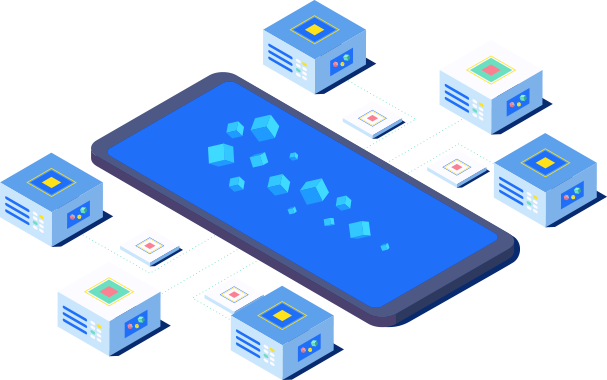
Illustration: Hosting an AI SaaS Product: Architecture and Scaling TipsGPU Hosting Infrastructure for AI APIs
GPU Selection for Model Serving: Matching Hardware to Workload
The GPU you select for serving AI inference in your SaaS product is the single largest determinant of your per-request cost and your latency floor, and the selection criteria are more nuanced than comparing teraflop numbers on a specification sheet. For serving 7B–8B parameter models at FP16 precision — the sweet spot for many AI SaaS products balancing quality, latency, and cost — an NVIDIA L40S (48 GB VRAM) or RTX 4090 provides sufficient memory capacity and delivers 35–50 tokens per second of output throughput at a cost of $1.40–$2.80 per GPU-hour. For 70B parameter models at INT4 quantization, a single L40S can serve the model with ~85 tokens per second at approximately $2.20 per GPU-hour, though FP16 precision on these larger models requires two L40S instances or a single A100/H100. The economic calculus shifts with utilization: a GPU that processes 1,000 requests per hour has a per-request cost ten times lower than a GPU processing 100 requests per hour, because the hourly rental cost is fixed regardless of throughput. This makes continuous batching — the technique of dynamically grouping concurrent inference requests into a single forward pass through the model — the single most impactful cost optimization for GPU inference hosting, capable of increasing throughput by 3–8× compared to processing requests one at a time. For teams evaluating whether to self-host models or use API providers, our self-hosted vs API cost comparison provides break-even analyses across GPU types, model sizes, and monthly token volumes.
Self-Hosted vs API-Based Inference: The SaaS Economics
The decision between self-hosting open-weight models on GPU infrastructure and calling managed APIs (OpenAI, Anthropic, Google) is the most consequential cost decision an AI SaaS company makes. API-based inference charges per token — GPT-4o costs $2.50 per 1M input tokens and $10.00 per 1M output tokens — which makes it economically optimal for low-volume, variable, or prototype-stage workloads. Self-hosted inference charges per GPU-hour regardless of token throughput, which makes it economically optimal for sustained, high-volume workloads where the fixed GPU cost is amortized across millions of tokens. The break-even threshold for a typical AI SaaS product serving a 7B–8B parameter model is approximately 15,000–20,000 queries per day with realistic prompt lengths (2,000–4,000 tokens of context). Below that volume, API pricing is cheaper even before accounting for operational overhead. Above that volume, self-hosting on a single L40S GPU at $400–$600 per month delivers 3–8× cost savings compared to API-based inference. The practical migration path we recommend at Hosting Captain is to launch on APIs, establish baseline token consumption patterns over three to six months, and transition to self-hosted infrastructure once sustained volume crosses the break-even threshold — maintaining API access as a fallback for traffic spikes and for the most demanding reasoning tasks that require frontier model quality not yet available in open-weight alternatives. For a broader perspective on how AI-powered interfaces are reshaping user expectations and infrastructure demands, our analysis of AI-powered uptime monitoring and predictive alerts examines the operational practices that keep AI inference endpoints reliable at scale.
Model Serving Infrastructure: From Prototype to Production Fleet
Model Serving Frameworks: vLLM, TensorRT-LLM, and TGI Compared
The model serving framework you choose sits between your application code and the GPU, and its throughput efficiency directly determines how many requests your GPU infrastructure can handle — and therefore your per-request cost. vLLM has become the de facto standard for open-source model serving in 2026, offering PagedAttention-based continuous batching that dynamically allocates GPU VRAM to concurrent requests and achieves 2–5× higher throughput than naive request-at-a-time serving. vLLM supports a wide range of model architectures (Llama, Mistral, Qwen, DeepSeek), integrates with OpenAI-compatible API endpoints for drop-in compatibility with existing application code, and runs efficiently on single-GPU and multi-GPU configurations. TensorRT-LLM, NVIDIA's optimized inference engine, delivers the highest absolute throughput — typically 20–40% faster than vLLM for FP16 models on NVIDIA hardware — but requires model compilation steps and has a narrower set of supported architectures. Text Generation Inference (TGI) from HuggingFace provides a production-grade serving layer with built-in quantization, watermarking, and safety filtering, and is the most approachable option for teams already invested in the HuggingFace ecosystem. For the majority of AI SaaS products deploying 7B–70B parameter models, vLLM represents the optimal balance of throughput, compatibility, and operational simplicity, and it is the serving framework we pre-configure on Hosting Captain's GPU instances.
Continuous Batching and Throughput Optimization
Continuous batching is the technique that separates GPU inference infrastructure that operates at 20% utilization from infrastructure that operates at 70–85% utilization — a difference that can halve or quarter your effective per-token cost. Traditional static batching waits for a fixed number of requests to accumulate before executing a forward pass, which means the GPU sits idle while the batch fills and individual requests experience queuing delays proportional to batch size. Continuous batching, implemented by vLLM and TensorRT-LLM, dynamically adds and removes requests from the active batch as they arrive and complete, keeping the GPU's tensor cores saturated without introducing artificial batching delays. The throughput improvement is most dramatic under variable load — the traffic pattern that characterizes almost every AI SaaS product — because continuous batching absorbs request bursts without the start-stop utilization pattern of static batching. The operational implication is that a GPU instance serving with continuous batching can handle 3–5× more concurrent users at equivalent latency compared to naive serving, which means you need fewer GPU instances for a given workload and your infrastructure cost per customer is proportionally lower. Configuring continuous batching correctly — setting maximum batch size based on available VRAM, tuning the scheduler policy for your workload's latency sensitivity, and monitoring batch utilization as a key GPU metric — is one of the highest-leverage infrastructure optimizations available to an AI SaaS team.
Scaling from Prototype to Production: A Phased Roadmap
Phase One: The Prototype (0–100 Users)
During the prototype phase, the correct infrastructure posture is maximum velocity with minimum fixed cost. Deploy your application on a single VPS hosting instance with 4–8 vCPUs and 16–32 GB of RAM for the orchestration layer, and use API-based inference (OpenAI, Anthropic, or Gemini) for all LLM calls. This eliminates GPU infrastructure management entirely during the phase when you are validating product-market fit and your token volume is too low to justify the fixed cost of a GPU instance. For the vector database — if your AI SaaS product uses RAG — use pgvector on the same PostgreSQL instance that stores your application data, which adds vector search capability with zero additional infrastructure. The entire stack costs $50–$150 per month and can be provisioned in under an hour. The key discipline at this stage is instrumenting token consumption and request latency from day one, so that you accumulate the usage data needed to make informed infrastructure decisions when you enter the growth phase. The prototype architecture should be designed with clean interfaces between the application code and the model inference calls — an abstraction layer that can be redirected from API endpoints to self-hosted endpoints without rewriting application logic.
Phase Two: The Growth Phase (100–10,000 Users)
The growth phase begins when your AI SaaS product has validated product-market fit, your daily active users are growing predictably, and your monthly API inference bill has crossed approximately $2,000–$3,000 — the threshold where self-hosting a GPU instance begins to deliver cost savings. The canonical architecture at this stage separates concerns across three tiers: a GPU server (or managed GPU instance) running vLLM for model inference, a dedicated database server (PostgreSQL with pgvector, or a purpose-built vector database like Qdrant if your vector corpus exceeds 1M chunks), and one to two application servers behind a load balancer for the orchestration layer. Redis is introduced for caching frequent queries and their retrieved contexts, which can reduce vector database load and LLM API costs by 40–60% for AI SaaS products with repetitive query patterns. Infrastructure-as-code (Terraform or Pulumi) becomes essential at this stage to manage the multi-server topology reproducibly, and CI/CD pipelines with staging environments become necessary to validate model updates and prompt changes before they reach production. Total monthly infrastructure cost ranges from $800 to $2,500, and the operational investment shifts from "keep the server running" to "monitor GPU utilization, track per-request latency, and manage model version rollouts." Our guide to AI-powered website builders and hosting provides additional context on how AI capabilities are reshaping the infrastructure expectations that users bring to SaaS products at this stage of growth.
Phase Three: The Scale Phase (10,000+ Users)
At scale — when your AI SaaS product is serving tens of thousands of daily active users and processing hundreds of millions of tokens per month — the architecture transitions to a multi-GPU, multi-region deployment with sophisticated traffic management. The GPU tier expands to a fleet of 4–16 GPU instances behind a model-aware load balancer that routes requests based on model capability (a smaller, cheaper model for simple queries; a larger model for complex reasoning) and GPU utilization. The vector database tier scales horizontally with sharding and read replicas to handle billions of document chunks and thousands of queries per second. The orchestration layer runs on a Kubernetes cluster with horizontal pod autoscaling based on request queue depth. A Redis or similar caching layer implements semantic caching — caching not just exact query matches but semantically similar queries that map to the same retrieved context — which is uniquely valuable for AI SaaS products where users ask the same questions with different phrasing. Multi-region GPU deployment places inference endpoints in geographic proximity to user populations, reducing round-trip latency by 50–150ms for globally distributed user bases. At this scale, the per-query infrastructure cost can be driven below $0.001, and the infrastructure investment that differentiates successful AI SaaS products is not raw GPU capacity but the orchestration intelligence — model routing, semantic caching, continuous batching optimization, and multi-region latency management — that extracts maximum throughput and minimum latency from the GPU fleet. The W3C standards for web interoperability increasingly influence how AI SaaS products expose their functionality through standardized APIs and structured output formats, and tracking these standards ensures that your product's integration surface remains compatible with the broader web ecosystem as it evolves.
Database Choices for AI SaaS Applications
Vector Databases: The Retrieval Backbone
If your AI SaaS product uses RAG, semantic search, or any form of embedding-based retrieval, the vector database is as critical to your architecture as your primary application database — and in many deployments, it handles more query volume because every user interaction triggers a vector search. The vector database landscape in 2026 has matured into a clear hierarchy of options matched to scale. pgvector (PostgreSQL extension) is the right choice when your vector corpus is under 1 million chunks and you already operate a PostgreSQL database — it adds vector search to existing infrastructure with zero new services to manage and allows SQL JOINs between vector search results and relational metadata. Qdrant is the pragmatic default for mid-scale deployments (1M–50M vectors), offering a single-binary deployment with excellent ANN search performance via its Rust-based HNSW implementation, on-disk indexing for collections larger than available RAM, and a purpose-built API with payload filtering. Milvus is the choice for billion-scale vector collections, with distributed architecture supporting horizontal scaling across data, query, and index nodes, and GPU-accelerated index construction — but it demands operational expertise in distributed systems that Qdrant and pgvector do not. Pinecone and Zilliz Cloud offer fully managed vector database services that eliminate operational burden at a pricing premium of 3–5× over self-hosted alternatives. For AI SaaS products where the engineering team does not have dedicated infrastructure expertise, the managed premium for the vector tier is often the most cost-effective insurance policy in the stack — the vector database is stateful, and losing it means losing every embedding in your knowledge base.
Relational + Vector Hybrid Architectures
The most powerful AI SaaS database architectures combine relational and vector capabilities within a unified query plane. A customer support AI SaaS product, for example, needs to retrieve semantically relevant documentation chunks (vector search), filter results by the customer's subscription tier and product version (relational filtering), and join the results against the customer's support history (relational join). PostgreSQL with pgvector enables this hybrid query pattern natively: a single SQL query can perform an ANN vector search, filter by tenant ID and metadata fields, and JOIN against relational tables — all within the transaction guarantees and operational maturity of PostgreSQL. The alternative pattern — running a dedicated vector database alongside a relational database — requires the application layer to perform two queries, merge results, and handle consistency across systems, which adds latency and complexity to every request. For AI SaaS products under 1–2 million document chunks, the pgvector-on-PostgreSQL hybrid architecture is the strongest default choice because it eliminates the operational and consistency overhead of a separate vector database while providing sufficient retrieval performance for the vast majority of use cases. The vector index tuning — choosing between HNSW and IVFFlat, setting the ef_search and m parameters — has a larger impact on query latency than the choice of vector database engine itself, and teams that invest time in index configuration benchmarking see 2–5× improvements in ANN search performance on the same hardware.
Cost Management for AI SaaS Infrastructure
GPU Cost Optimization: Utilization Is Everything
The dominant cost driver for any self-hosted AI SaaS product is GPU rental, and the dominant lever for GPU cost optimization is utilization — the percentage of time the GPU is actively processing inference requests rather than sitting idle. A GPU instance that costs $500 per month and runs at 25% utilization has an effective cost of $2,000 per month of actual compute time, because 75% of the rental cost is wasted on idle cycles. The practices that drive utilization toward the 70–85% range include: continuous batching to keep the GPU saturated under variable load; request queuing with priority tiers (real-time user-facing requests processed immediately, batch analysis jobs processed during idle periods); scheduled auto-scaling that provisions additional GPU instances before known traffic peaks (morning login surges, weekday business hours) and scales down during lulls; and model multiplexing — serving multiple fine-tuned model variants or multiple smaller models from a single GPU instance by partitioning VRAM, which is feasible with vLLM's multi-model serving capabilities. Spot and preemptible GPU instances, available at 60–80% discounts from major cloud providers, are viable for stateless inference workloads with proper checkpointing and graceful degradation logic — if a spot instance is reclaimed, traffic routes to on-demand instances while a replacement provisions. At Hosting Captain, our GPU instances are provisioned with utilization monitoring dashboards and automated right-sizing recommendations that alert teams when GPU capacity exceeds or falls short of workload requirements.
Token Budgeting, Model Tiering, and Caching Economics
Beyond GPU utilization, the architectural patterns that control AI SaaS costs are token budgeting, model tiering, and caching. Token budgeting means establishing per-user or per-request token limits that cap the maximum cost of any single inference call — preventing a user who uploads a 50-page document and asks "summarize this" from consuming $0.50 of inference cost in a single request. Model tiering means routing requests to the cheapest model that can handle them: simple classification and extraction tasks go to a small, fast model (Llama 3 8B or even a BERT-based classifier), while complex reasoning and generation go to a larger model or a frontier API. A well-implemented model tiering router can direct 60–80% of traffic to the cheapest tier while preserving full quality on the demanding 20–40% of requests, delivering 40–60% total inference cost reduction without user-perceptible quality degradation. Semantic caching — storing the results of previous inference calls keyed by their semantic fingerprint rather than exact string match — is uniquely valuable for AI SaaS products because users frequently ask semantically equivalent questions in different words. A semantic cache with an 80% hit rate reduces GPU inference load by 80%, which directly reduces the number of GPU instances required and therefore the monthly infrastructure bill. Implementing these three patterns — token budgeting, model tiering, and semantic caching — transforms the cost structure of an AI SaaS product from linear-with-usage to sub-linear-with-usage, which is the cost trajectory that makes AI SaaS businesses economically viable at scale.
Monitoring AI Workloads in Production
GPU-Specific Metrics That Matter
Monitoring an AI SaaS product requires extending traditional server observability — CPU, memory, disk, network — with GPU-specific metrics that directly measure inference performance and cost efficiency. The essential GPU metrics are: GPU utilization (percentage of tensor cores actively computing, target 70–85%), VRAM usage (percentage of GPU memory consumed by model weights and KV cache, target below 90% to leave headroom for batch growth), tokens per second (output throughput, the primary measure of serving efficiency), time-to-first-token (TTFT, the latency from request arrival to first token output, the primary measure of user-perceived responsiveness), request queue depth (number of requests waiting for GPU capacity, the leading indicator of saturation), and batch size distribution (how many requests are being processed concurrently in each forward pass, the measure of continuous batching effectiveness). These metrics should be collected per GPU instance and aggregated across the fleet, with dashboards that show both real-time values and historical trends. Alerting thresholds should be set on request queue depth (leading indicator of user-facing latency degradation) and TTFT p95 (direct measure of user experience), not on GPU utilization alone — a GPU at 100% utilization with a well-managed queue and acceptable TTFT is operating correctly, not alerting.
Latency Budgeting Across the AI Pipeline
An AI SaaS product's end-to-end latency is the sum of serial stages — embedding time, vector search time, LLM time-to-first-token, token generation time, and network round-trips between tiers — and each stage must be allocated a latency budget that collectively meets the product's response time target. For a customer-facing AI SaaS product targeting a 2-second end-to-end response, a well-tuned pipeline allocates approximately: 50–100ms for query embedding, 20–50ms for vector search (HNSW index in memory), 100–300ms for LLM prompt processing and time-to-first-token, and 1,000–1,500ms for token generation (30–40 tokens at 25–40 tokens per second). Network latency between components must be under 5ms, which mandates same-datacenter colocation of all pipeline stages. The monitoring system must trace each stage of every request — distributed tracing with OpenTelemetry spans across the embedding service, vector database, and LLM serving endpoint — so that latency regressions can be attributed to the specific component causing them rather than burning engineering hours on a system-wide investigation. Tenant-scoped latency metrics are equally important: a p99 latency spike caused by a single enterprise customer uploading a 100-page document for analysis is a different operational response than a system-wide degradation, and tenant-scoped observability is the capability that separates AI SaaS operations teams that sleep through the night from those paged at 3 a.m. for single-customer issues. Our AI monitoring guide covers the predictive alerting patterns that detect latency regressions before they impact users.
Hosting Captain's AI SaaS Infrastructure: Purpose-Built for the Inference Era
At Hosting Captain, we have designed our GPU-accelerated hosting infrastructure specifically for the workloads that AI SaaS products generate: sustained, high-intensity compute requiring predictable latency, reliable GPU availability, and integrated monitoring across the full stack. Our GPU instances — spanning NVIDIA L40S, A100, and H100 configurations — are provisioned with pre-configured model serving frameworks (vLLM, TensorRT-LLM, TGI), continuous batching enabled by default, and utilization dashboards that provide real-time visibility into GPU throughput, VRAM consumption, and request latency distributions. We colocate GPU instances with CPU-optimized VPS and dedicated server options for the orchestration, database, and caching tiers, ensuring that every component of an AI SaaS pipeline operates within the same low-latency network fabric. Our managed database offerings include PostgreSQL with pgvector pre-configured for hybrid relational-vector workloads, and our support team includes engineers with production experience deploying and scaling AI inference infrastructure — not just generalist Linux administrators reading from a script. For AI SaaS teams evaluating their infrastructure options, whether you are launching your prototype on a managed VPS or scaling a production GPU fleet across multiple regions, Hosting Captain's AI hosting infrastructure is built to serve as the foundation that carries your product from the first inference call to the billionth, without requiring an infrastructure rebuild at each stage of growth.
Frequently Asked Questions
What is the minimum infrastructure needed to launch an AI SaaS product?
For an AI SaaS MVP, the minimum viable infrastructure is a single VPS with 4–8 vCPUs and 16–32 GB of RAM ($40–$80/month) for the application and orchestration layer, PostgreSQL with pgvector for the database and vector store, and API-based inference (OpenAI, Anthropic, or Gemini) for all LLM calls. This stack eliminates GPU infrastructure management during the validation phase, costs $50–$150 per month total, and can be provisioned in under an hour. The application should be built with an abstraction layer between the code and the model inference calls, so that migrating from APIs to self-hosted models later requires redirecting endpoints rather than rewriting application logic. This architecture supports 100–500 beta users comfortably and provides the usage data needed to make informed infrastructure decisions when the product enters the growth phase.
When should I switch from API-based inference to self-hosting models?
The economic break-even point for migrating from API-based inference to self-hosted GPU infrastructure is approximately 15,000–20,000 queries per day with realistic prompt lengths of 2,000–4,000 tokens. Below this volume, API pricing (GPT-4o at $10/1M output tokens, or GPT-4o-mini at $0.60/1M output tokens) is cheaper than renting a dedicated GPU instance at $400–$600 per month, even before accounting for the operational overhead of managing GPU infrastructure. Above this volume, self-hosting on a single L40S GPU delivers 3–8× cost savings. The recommended migration path is to launch on APIs, accumulate three to six months of token consumption data, and transition latency-tolerant workloads to self-hosted infrastructure once sustained volume crosses the break-even threshold — maintaining API access as a fallback for traffic spikes and for the most demanding reasoning tasks that require frontier model quality.
Which GPU should I rent for serving a 7B or 70B parameter model?
For serving a 7B–8B parameter model at FP16 precision, an NVIDIA L40S (48 GB VRAM) or RTX 4090 provides sufficient memory capacity and delivers 35–50 tokens per second of output throughput at $1.40–$2.80 per GPU-hour. For a 70B parameter model at INT4 quantization (sufficient for most production use cases with 95–98% of FP16 benchmark performance preserved), a single L40S can serve the model at ~85 tokens per second for approximately $2.20 per GPU-hour. For 70B models at FP16 precision, two L40S instances ($4.40/hour) or a single A100 ($3.00–$4.50/hour) are required due to VRAM constraints. Hosting Captain offers pre-configured GPU instances optimized for these model profiles, with vLLM pre-installed and continuous batching enabled by default.
Do I need a separate vector database for my AI SaaS product?
Not necessarily as a separate service. If your AI SaaS product uses RAG or semantic search with under 1–2 million document chunks, PostgreSQL with the pgvector extension handles vector search within your existing database infrastructure, supporting SQL JOINs between vector search results and relational metadata in a single query. This hybrid relational-vector architecture eliminates the operational overhead of a separate vector database and is sufficient for the majority of AI SaaS products through the growth phase. A dedicated vector database (Qdrant, Milvus, or managed Pinecone/Zilliz Cloud) becomes necessary when your vector corpus exceeds 2–5 million chunks, when vector search throughput exceeds 100 queries per second, or when you need horizontal scaling across multiple nodes. The managed vector database premium (3–5× over self-hosted) buys automatic scaling, zero-downtime upgrades, and operational support — an investment that pays off for teams without dedicated infrastructure expertise managing stateful distributed systems.
How do I reduce the GPU costs of my AI SaaS product?
GPU cost reduction for AI SaaS products operates on three levers. First, maximize GPU utilization through continuous batching (which increases throughput 3–8× over request-at-a-time serving), request queuing that fills idle GPU cycles with batch work, and scheduled auto-scaling that provisions GPU capacity only when needed. Second, implement model tiering — route 60–80% of requests to a smaller, cheaper model (Llama 3 8B) and reserve larger models or API calls for the 20–40% of requests that genuinely require them, achieving 40–60% inference cost reduction without quality degradation. Third, implement semantic caching — store inference results keyed by semantic fingerprint so that semantically equivalent queries are served from cache rather than triggering new GPU inference, which can reduce GPU load by 40–80% for products with repetitive query patterns. Together, these three practices can reduce GPU infrastructure costs by 60–80% compared to a naive single-model, no-caching deployment.
How do I handle traffic spikes without over-provisioning GPU instances?
GPU instances take 30–90 seconds to cold-start (provisioning plus model weight loading), which is too slow for reactive auto-scaling to absorb a traffic spike without user-visible latency degradation. The effective strategy combines three practices. First, provision baseline GPU capacity at 1.3–1.5× your measured peak QPS to provide headroom for moderate spikes without cold starts. Second, use scheduled auto-scaling that provisions additional GPU instances 10–15 minutes before known traffic peaks (morning login surges, weekday business hours, scheduled marketing events) based on historical diurnal patterns. Third, implement a request priority queue — real-time user-facing requests processed immediately on the GPU fleet, batch and background analysis jobs queued for processing during idle periods or on spot instances — so that traffic spikes affect batch throughput rather than user-facing latency. For products with highly variable traffic, maintaining a small pool of on-demand GPU instances for baseline load and using spot/preemptible instances for elastic capacity can reduce costs by 40–60% compared to provisioning entirely on-demand.
What monitoring metrics are most important for an AI SaaS product?
The critical monitoring metrics for an AI SaaS product extend beyond traditional server observability to include GPU-specific and AI-pipeline metrics. GPU utilization and VRAM usage measure infrastructure efficiency. Tokens per second and time-to-first-token (TTFT) measure inference performance and directly correlate with user experience. Request queue depth is the leading indicator of GPU saturation — when the queue grows, latency will follow. End-to-end request latency, traced across embedding, vector search, and LLM generation stages via distributed tracing, enables rapid attribution of latency regressions to the specific component causing them. All metrics should be scoped by tenant identifier so that single-customer issues (a user uploading a 100-page document) are distinguishable from system-wide degradation. Alert thresholds should be set on TTFT p95 and request queue depth rather than on GPU utilization alone — a GPU operating at 100% utilization with acceptable latency is functioning correctly.
Can I run an AI SaaS product on shared hosting?
No. Shared hosting environments lack the resource isolation, persistent storage guarantees, GPU access, and software installation flexibility required by any tier of an AI SaaS stack. An LLM inference engine requires dedicated GPU compute with consistent VRAM allocation. A vector database needs guaranteed RAM for in-memory index performance and persistent storage with predictable I/O. Even the orchestration layer benefits from dedicated CPU and the ability to install system-level dependencies like CUDA libraries and inference engine runtimes. The minimum viable hosting tier for a production AI SaaS product is a VPS hosting instance or dedicated server with root access, guaranteed resources, and the ability to install and configure the specialized software that an AI pipeline depends on. Hosting Captain's VPS and GPU-accelerated server plans are designed specifically for this class of workload, with pre-configured environments for model serving, vector databases, and AI orchestration layers.
How does Hosting Captain support AI SaaS companies at different growth stages?
Hosting Captain provides managed hosting infrastructure mapped to each phase of the AI SaaS growth journey. For prototype-stage startups, our managed VPS plans with pre-configured PostgreSQL and pgvector provide the application and database foundation, while our team provides guidance on API-based inference integration and token consumption monitoring. For growth-stage products, our GPU-accelerated instances — L40S, A100, and H100 configurations with vLLM pre-installed and continuous batching enabled — provide the model serving infrastructure for self-hosted inference, colocated within the same low-latency network fabric as CPU-optimized instances for orchestration, database, and caching tiers. For scale-stage products, we offer multi-GPU fleet management, multi-region deployment capabilities, and infrastructure consulting for advanced patterns including model tiering routers, semantic caching layers, and Kubernetes-based orchestration. Across all stages, our support team includes engineers with production experience deploying and scaling AI inference infrastructure, providing operational expertise that complements our customers' product engineering capabilities.
This guide is based on Hosting Captain's operational experience provisioning and managing GPU-accelerated infrastructure for AI SaaS products across prototype, growth, and scale stages. Infrastructure pricing and model performance benchmarks reflect data as of Q1 2026. For a personalized infrastructure assessment of your AI SaaS product's hosting requirements, contact the Hosting Captain team for a complimentary architecture consultation.
Arjun Mehta is a cloud infrastructure consultant specializing in bare-metal architectures, network routing, and high-traffic database clustering.
Frequently Asked Questions
This guide covers the practical decision points — pricing, performance, and when it makes sense for your situation — based on current 2026 data.
Pricing varies by provider and plan tier; see the cost breakdown section above for current ranges and what's actually included at each price point.
Look closely at uptime guarantees, renewal pricing (not just the first-year discount), and how responsive support actually is — all covered in detail in this article.
Hosting Captain has been exceptional for my e-commerce store in Pune. The NVMe SSD speed is
noticeable, and their support team responds within minutes. Highly recommended for any
Indian business!
Ryan John, Pune
Great Value for Money
Switched from a US-based host to Hosting Captain and my website loads 3x faster for Indian
visitors. The free SSL and cPanel are great, and the pricing is unbeatable. Very satisfied
customer!
Priya Mehta, Mumbai
Reliable VPS Hosting
I've been using their VPS plan for 2 years now. 99.9% uptime is not just a claim — it's
reality. My client projects run without interruption. The KVM virtualization gives me full
control I need.
Amit Kumar, Bangalore
Excellent 24/7 Support
The support team helped me migrate my entire WordPress site at 2 AM without any downtime.
This level of service is rare in Indian hosting. Worth every rupee!
Sunita Patel, Ahmedabad
Perfect for Startups
As a startup, budget matters. Hosting Captain's Business plan covers everything we need —
multiple websites, free SSL, daily backups — at a fraction of what international hosts
charge.
Vikram Singh, Delhi
Professional Dedicated Server
Our high-traffic news portal needed a dedicated server. Hosting Captain's DS Business plan
handles 100K+ daily visitors effortlessly. Their team provisioned everything within 4 hours!
Meena Krishnaswamy, Chennai
Trusted Technologies & Partners
Start Your Website with Hosting Captain
From personal blogs to enterprise solutions, we've got you covered!